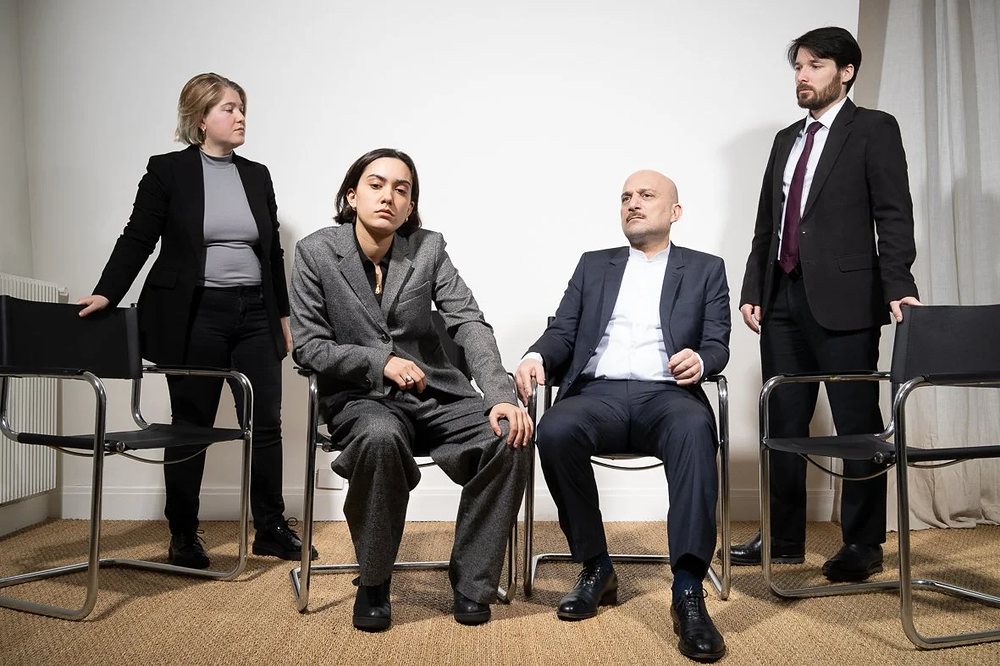
On stage, not actors but a real Extinction Rebellion activist facing a climate-sceptic far-right politician, flanked by two more moderate political figures. Their goal: to find a way out of the tragedy and to seek a solution together. The question that drives them: are we destined for tragedy?
La Nouvelle Antigone is a unique show blending theatre, politics and ecology. At the crossroads of democracy and tragedy, it asks: are we still capable of debating with our ideological opponents?
The play offers a contemporary reading of the Antigone myth: the heroine becomes an environmental activist, Creon an authoritarian president, and the tragedy plays out once more on the scale of the climate. The show oscillates between debate and myth: roles blur, and fiction and reality become dangerously intertwined. This blurring of boundaries questions our collective ability to rewrite history — or to repeat it.
Statement of intent
A debate
The show opens with a debate between four politicians representing opposing ideological positions, gathered around a burning issue – the climate crisis. Together they try to find a way through it. How can we debate when everything divides us? Theatre, with its 2,000 years of experience of tragedy and its dead ends, becomes the ideal frame for asking questions. Through this device, contemporary political stakes take on a concrete, vivid, almost physical form: that of a high-tension ideological confrontation.
A myth
The participants in the debate lend themselves to a theatrical exercise: performing extracts from La Nouvelle Antigone. In this play, inspired by the ancient myth, each character finds the contours of their deepest convictions. The radical activist becomes Antigone; the authoritarian elected official, a contemporary Creon. The boundaries between fiction, myth and reality blur. Every line takes on a double meaning, and the mythological characters seem to mirror our own times exactly.
A present-day issue
Why stage Antigone again in 2025? Because this myth, endlessly rewritten (from Sophocles to Anouilh, from Cocteau to Brecht), still speaks to us. In La Nouvelle Antigone, Frédérique Zahnd places the central conflict on a new horizon: that of the ecological crisis. Antigone no longer defends only a brother, but a generation, a future, a planet. The play thus becomes a committed, contemporary rereading: civil disobedience, climate activism, feminism, the exhaustion of public debate... everything converges on this tragic figure who resists at the cost of her life. But can another ending be written?
A tragedy
Through this play of mirrors between political debate and theatrical tragedy, the show asks: are we capable of escaping fate? Can Antigone be saved – and, symbolically, what she embodies? The characters in the debate call for another ending, for an alternative to sacrifice. But the tragic mechanism is relentless. Every attempt at reconciliation fails; every word spoken brings them closer to a point of no return. La Nouvelle Antigone thus sets theatre against reality, utopia against impasse, to ask an essential question: faced with the foretold catastrophe, will we too tirelessly repeat the mistakes that inevitably lead to tragedy?
Text
The text of the show is based on the work by Frédérique Zahnd. Marek M. Chojecki's adaptation presents major extracts from the original work while integrating the theme of political debate and of the actors/politicians. The discussions, altercations, interruptions and monologues of the debate are the result of devised writing in rehearsal.
Frédérique Zahnd – A holder of the agrégation in modern literature and a literary critic, she writes for publications including Esprit and La Pensée Écologique, and recently collaborated with LaRevueDurable on young people's involvement in the ecological transition. La Nouvelle Antigone, le mythe s’empare du climat (Unicité, 2022) draws on the civil disobedience led by young people, notably through the Extinction Rebellion movement — a cause in which she herself takes part.