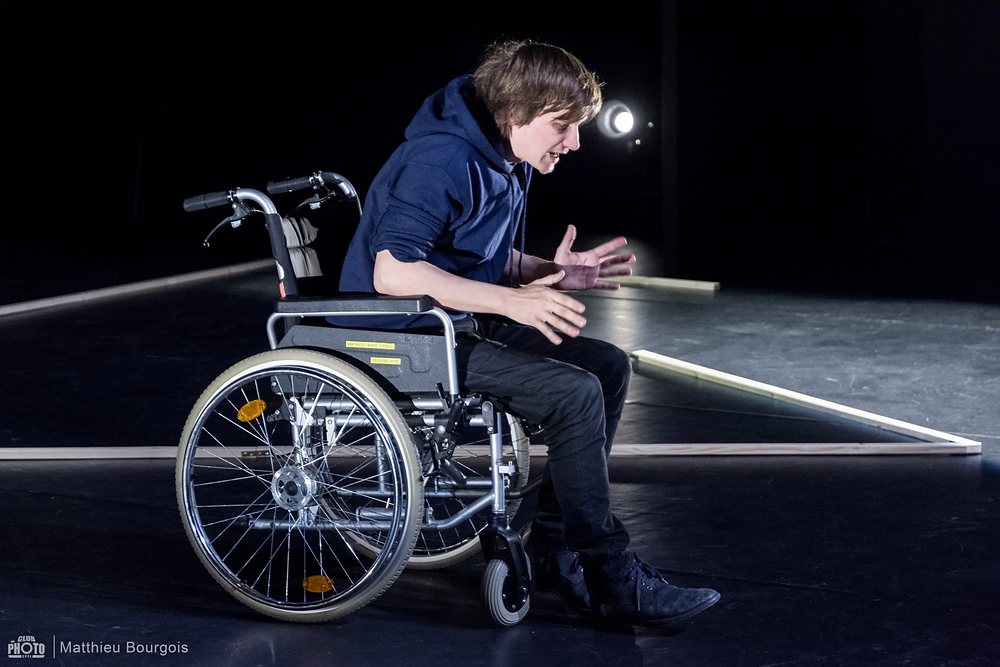
Sur le départ is the story of a politician at the end of his term of office. Leaving power after a whole life spent in politics and at the head of state, he must face a new life in which power and influence are no more. Caught up by his past schemes, manipulated by his opponents, used by the media and refusing to believe he has lost popular support, this departing politician illustrates the realities of the political world and the difficulty of leaving it unscathed.
Sur le départ presents a political world that is absurd but also very real and universal. The classics are thus woven into the story, with entire passages borrowed from Shakespeare or Chekhov. A King Lear appears, lost in his ruined kingdom: a former head of state's descent into madness. A nobility degenerating and disappearing through the themes of The Cherry Orchard. Together these form a text that questions public and political figures. What happens to those who lose power?
But it is far more than a simple story: Sur le départ is a reflection on theatre, on directing and on actors, a kind of introspection by the playwright on the writing of his work – an author's power over his work and his characters. Hence the show is regularly interrupted by the author walking on stage, freezing the action and the actors. But this author is none other than Václav Havel – on the edge between the real and the absurd, he shares with the audience his remarks and reflections on his play, but also on his rich life experience. With a life that is a curious mixture of dissident, politician and playwright, what can he teach us?
Sur le départ thus tells two stories in parallel: the one told by the author, and that of the author himself, the fascinating Václav Havel.
Václav Havel went through several phases in his life. His period as a playwright stretches mainly from 1960 to 1989, alongside his opposition to the communist regime, before giving way to a political phase as president at the head of the country from 1989 to 2003, during which he wrote no more plays. It therefore seems clear that one of Havel's motivations and inspirations was his country's struggle to free itself from the yoke of communist dictatorship and to achieve freedom. That done, he concentrated on rebuilding the country, where, it would seem, playwriting no longer had a place. So when Havel took up his pen again in 2007 and wrote Sur le départ (Odcházení), or The Comedy of Power, one wonders: what does he have to pass on to us? Almost twenty years after his last play, at the age of 71, with a life experience that is a curious mixture of dissident, politician and playwright, what can he teach us? What did Václav Havel decide to leave as a legacy in one of his last written traces?
“I was interested — and indeed I still am — in the more general and existential nature of things. I was interested in how it is that when a person loses power, they also lose the meaning of life. Why does power have such charisma for some people that losing it means the collapse of their world?”Václav Havel